MARTIN
LUTHER
KING, ABRAHAM LINCOLN
AND
THE ENGLISH
CLASSROOM
by
Dennis Lawrence
I spent the better part of an hour looking for his grave in Arlington
National
Cemetery before I asked a park ranger for help. He informed me of what
I should have known, that Martin Luther King was buried where he was
born
in Atlanta, Georgia. As I turned away he chuckled and said, " You don't
think Martin King would have gotten himself buried in Robert E. Lee's
front
yard, do you?"
My mistake was easy enough to rationalize; as a young man I had watched
John, Martin, and Bobby laid to rest in day long television funerals,
and
I swear I saw those mules carry Martin across the Potomac bridge to the
"front yard" of what had been Robert E. Lee's pre-Civil War home. As I
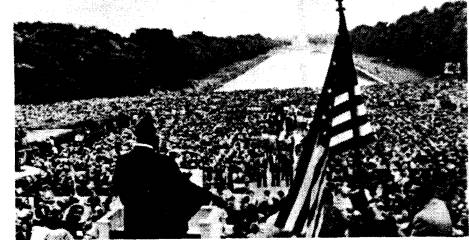
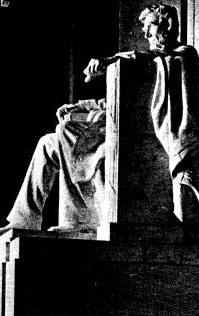
stood on the Custis-Lee Mansion's lawn, I looked across the Potomac to
the steps of the Lincoln memorial where Martin had made his greatest
speech
under the stony gaze of Abraham Lincoln.
Dr. Martin Luther King made that speech just four months short of one
hundred
years after Lincoln spoke at Gettysburg, and King died just five days
short
of the 103rd anniversary of Robert E. Lee's surrender at Appomatox. But
the racial inequality King fought against dates to the failed promise
of
Lincoln's Gettysburg Address and Lee's surrender.
The writings of Abraham Lincoln and Martin Luther King deserve to be
studied
in the English classroom as rhetorical models, but they should also be
presented as mirrors of the past in whose reflection we see that the
slavery
of the Civil War, the bigotry of the years after it, and our racial
discord
today stem from the same problem ; the refusal to accept all men
as equals.
Lincoln: wrestling in the midst of a great Civil War to both preserve
the
Union and free the slaves, but only when he believed he could do
both.
King: struggling to keep his country out of a racial struggle perhaps
more
violent than the first, yet firmly committed to achieving the
acceptance
of African-American as the equal of any other American.
Discussions
of the writings of these two men in the English classroom should focus
on how both labored to gain equality for all and on how our students
need
to do the same.
Lincoln a racist? The charge appalls me, but not some of my students
who
have formed this opinion based on the superficial Lincoln they have
encountered.
I ask students to look at the complex Lincoln as found in his reply to
an 1862 newspaper editorial which called for an immediate emancipation
of slaves something which Lincoln was not yet prepared to announce.
Finding
himself caught between the forces who demanded immediate abolition of
slavery
and those who wanted no part of such an action, Lincoln tried to pacify
both sides in this reply.
"If I could free the Union without freeing any slaves I would do it;
and
if I could save it by freeing all the slaves I would do it; and if I
could
save it by freeing some and leaving others alone, I would also do that."
This seemingly apathetic view toward the abolition of slavery is
sometimes
construed as racist by my students; perhaps it is, but I ask them to
balance
this with what Lincoln said just a year later when he rose to dedicate
the National Cemetery at Gettysburg, Pennsylvania. There he once and
for
all dismissed our Constitutional forefathers' curious arithmetic that
equated
a Black citizen to three-fifths of a human being. The famous opening
five
words overshadow the more important final five words.
Four score and seven years ago, our forefathers brought forth on this
continent
a new nation, conceived in liberty and dedicated to the proposition
that
all men are created equal.
Lincoln's rounding off of the Constitutional fraction was his moral
mathematical
assertion that the war was as much about freedom and equality for
Blacks
as it was about preserving the Union; indeed, he combined these two
concepts
near the end of the speech when he declared "...this nation, under God
shall have a new birth of freedom." Students who are asked to discuss
Lincoln's
apparent change of heart on slavery may discover that he had waited
only
until the moment was right; if students are then asked to reflect on
their
own struggles with racial prejudice, perhaps Lincoln becomes not a
racist,
but a role model for Americans today.
Lincoln eventually came to believe that the four years of unimaginable
bloodshed was God's punishment for all Americans' implicit acceptance
of
slavery, and he did not exempt himself from such condemnation. In his
"Second
Inaugural Address," he spoke of a punishment lasting far beyond the
Civil
War.
Yet, if God wills that it (war) continue until... every drop of blood
drawn
with the lash, shall be paid by another drawn with the sword, as was
said
three thousand years ago, so still it must be said 'the judgments of
the
Lord are true and righteous altogether.'
Lincoln's words ring down through the ages like a curse dooming
Americans
to racial discord until we finally accept the concept of equality.
Students
who read this and other Lincoln speeches, will discover Lincoln's
efforts
to find freedom within the Union for all Americans. Abraham Lincoln,
with
human flaws and heroic traits, is part of the common American heritage
whites and Blacks share. He was able to overcome not only the
overwhelming
political pressures of his time, but also, perhaps, his own misgivings
about equality. This struggle is worthy of emulation for all Americans,
white and Black.
Dr. Martin Luther King struggled so. Like Lincoln, King was an American
who wrestled with the question of equality for all Americans in their
shared
homeland. Unlike Lincoln, who used sweeping legislative powers to make
laws freeing the slaves, King found it necessary to rely on an even
higher
authority to justify breaking immoral laws in order to make moral laws
freeing minority Americans. King, arrested by a man named "Bull Conner"
after an "illegal" demonstration, dealt with this question of laws and
morality in his "Letter From a Birmingham Jail."
There are two types of laws: there are just laws and there are unjust
laws.
I would agree with St. Augustine that an unjust law is no law at
all.'...
Any law that uplifts human personality is just. Any law that degrades
human
personalities is unjust. All segregation laws are unjust because
segregation
distorts the soul and damages the personality...
Just as Lincoln had found himself trapped between two extreme points of
view, so did King. He attempted to extricate himself through the logic
of a syllogism. It would not work that neatly. His assertion that he
could
break any laws he deemed immoral lost him the support of some whites
who
were sympathetic to the plight of minorities in a Jim Crow country, but
hesitant to advocate any action outside the law; his refusal to
advocate
more violent actions lost him the support of some Blacks who thought
only
aggressive actions would change the racist laws of a largely
unconcerned
nation.
Yet, King lifted the argument for racial justice through nonviolence to
a moral plane so far above the protests of these two extremes that when
he stood on the steps of the Lincoln Memorial that bright August day in
1963, he was already on the mountain top.
It would be a mistake, however, to paint for our students the tempting
portrait of Martin Luther King descending from heaven to the steps of
the
Lincoln Memorial godlike and infallible. The more accurate and valuable
picture for our students is that of a complex American searching for a
way to unite Americans who were poised on the brink of another civil
war.
Failure was a distinct possibility. When Dr. King spoke that day,
he spoke to an audience far beyond those jammed on the Washington Mall.
He spoke to an America as racially divided as the America Lincoln spoke
to at Gettysburg. He spoke of issues that had not been resolved by the
four years of fratricide, so he lectured Americans on how that 100?
year
old struggle still extended into their lives.
"Let Freedom ring," he thundered from the mountain top. And he spoke of
the future brotherhood between descendants of slaves and slave owners;
and he pointedly listed Stone Mountain, Georgia on whose face is carved
the images of Confederate heroes, as one spot where racial freedom must
ring. Then he turned to the state of racial relations in America today.
I
have a dream that one day the State of Alabama, whose governor's lips
are
presently dripping with the words of interposition and nullification,
will
be transformed into a situation where little black boys and black girls
will be able to join hands with little white boys and white girls and
walk
together as sisters and brothers.
Even though this speech was praised then and now as a rhetorical
masterpiece,
it rang hollow in the ears of some civil rights activists who wanted
concrete,
earthly plans, not dreams of the future. And as if in mocking answer to
King's dream, only eighteen days after his speech four of the "little
black
girls" of Birmingham, Alabama King had spoken of in his speech were
killed
by a bomb tossed into their Sunday School class. King's presence in
that
city immediately afterward saved not only the citizens of Birmingham,
but
perhaps the nation, from a racial bloodbath.
Students who study King's writings will see that his dream of equality
through nonviolence, even in the midst of this nightmare of violence,
is
one of the greatest examples of intellectual courage and moral
determination
demonstrated by any one American in our history. From this they
can
draw not only an understanding of the difficulty of the civil rights
struggle
then, but also an understanding of the commitment they too must make
toward
equality without violence today.
In his Nobel Peace Prize acceptance speech, King proclaimed the success
of his nonviolent approach as a victory won by all Americans.
I do not consider this merely an honor to me personally, but a tribute
to the wise and majestic courage of the millions of gallant Negro and
white
persons of good will who have followed a nonviolent course in seeking
to
establish a reign of justice and a rule of love across this nation of
ours.
Yet, there are few among us who would say that this justice and love
rules
across summation today, and in our English classrooms we need to
continue
the efforts of Dr. King to unite us. After admiring the imagery,
syntax,
and voice of Dr. King's speeches, we must turn the discussion to the
issues
he spoke of that have haunted our country since the first slave ships
touched
our shores.
An honest, open discussion of racial attitudes sparked by a study of
the
writings of Abraham Lincoln and Dr. Martin Luther King will undoubtedly
bring to the surface the racial tension many of our good hearted
students
often bury for the sake of "harmony"; we must be prepared to deal with
those emotional bruises incurred and suffered by our students. But this
is the type of discussion such pieces of literature demand if we are to
break down the barriers of racial misunderstanding in our classrooms
and
move toward equality in or society. Our task is more subtly
defined
than Lincoln's and King's; they fought against tangible, unjust laws.
We
must convince our students that these laws were only the surface
representation
of a racial prejudice that still exists. We will need all the help we
can
get to finally rid our nation of these attitudes. I suggest we get it
from
Martin and Abraham.
Whenever I return to the Lincoln Memorial, I walk to where Martin
Luther
King spoke. As I stand juxtaposed between the ghosts of these two great
Americans and the Confederate general's mansion across the river, I can
still picture those mules crossing the Potomac. Perhaps the
improbability
of Martin Luther King resting in the nation's foremost National
Cemetery
is the bitterest truth of our shared but unequal American heritage.
Perhaps
a study of the historical context of our racial turmoil through the
writings
of the two Americans who led the two greatest racial revolutions in our
country will lead to the necessary truths we must all discover before
we
can finally form one nation with not only liberty but justice for all.